
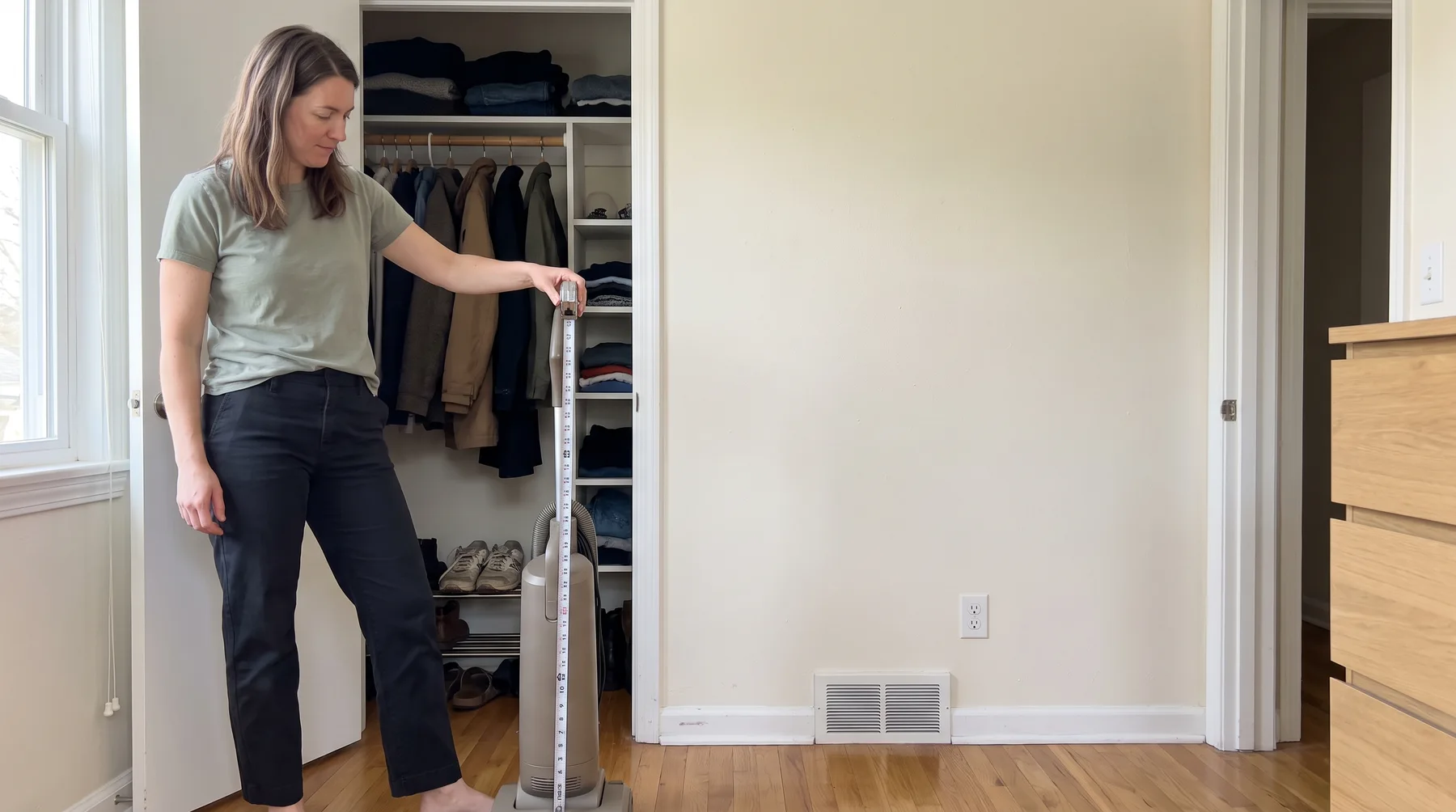
Deciding where to store vacuum in small apartment homes starts with measurements, not a list of clever hiding places. Measure the vacuum in the exact configuration you use for storage, note which parts can detach, and then compare possible locations based on access, stability, outlet needs, and lease restrictions.
The best spot is rarely the smallest possible gap. It is the smallest practical space that lets you take out the vacuum and put it away without moving furniture, untangling a hose, or rebuilding the setup after every cleaning.
Measure the vacuum in its actual stored configuration
Measure the vacuum while it is upright, folded, docked, or separated into the parts you realistically plan to store. Do not rely only on dimensions from a product listing. Handles may extend, hoses may bow outward, and floor heads may require more depth than the main body.
Record these measurements:
- Overall height, including the handle or charging dock
- Widest point, which may be the floor head rather than the motor housing
- Total depth, including hoses, wheels, brackets, and cord wraps
- Dimensions of removable parts you intend to store separately
- Cord length or charger reach if the location needs outlet access
Add a little working clearance around the vacuum. You need enough room to lift it over a closet threshold, tilt it out from behind a door, or remove it from a wall dock. A vacuum that technically fits but scrapes a wall or catches on hanging clothes is not a good fit.
Measure each possible storage area at its narrowest point. Closet trim, hinges, baseboards, door stops, shelf supports, and cabinet overhangs can reduce usable space.
How to decide where to store vacuum in small apartment layouts
Storage strategy depends on the vacuum type and how often you use it. A compact stick vacuum used every evening should be easier to reach than a full-size machine used twice a month.
Upright vacuums
An upright usually needs a tall, stable floor space. A narrow edge of a coat or bedroom closet often works if the floor head does not interfere with shoes and the handle clears the clothing rod.
Keep the machine fully supported on the floor. Do not balance it on a shelf or lean it where opening a door could knock it over. If the upright has a hose and attachments, store those beside it or in a small container above it rather than wrapping loose pieces around the handle.
Canister vacuums
A canister vacuum separates more easily, but its hose and wand can consume unexpected space. The canister may fit on a closet floor or under a bed while the wand stands vertically at the closet edge. Coil the hose according to the manufacturer’s instructions, without forcing a sharp bend.
Before splitting the components across two areas, consider whether you will reliably gather them each time. Keeping the canister, hose, and floor head within the same storage zone usually makes cleaning and resetting easier.
Stick vacuums
A stick vacuum can occupy a narrow wall section or closet edge, especially when it has a manufacturer-approved charging dock. If it folds or separates into a handheld unit and wand, measure both the assembled and disassembled configurations.
A charging location needs an outlet within the charger’s permitted reach. Avoid running a cord across a doorway, walkway, or heated surface. If the vacuum uses a removable battery, follow the manufacturer’s charging and storage directions rather than choosing a location based only on convenience.
Handheld vacuums
A handheld vacuum can fit on a shelf, inside a cabinet, or in a ventilated cleaning station. Keep its nozzle and charger with it. Do not bury it in a deep bin where pressing against other items could activate its controls or damage the charging connection.
Test realistic storage zones before rearranging the apartment
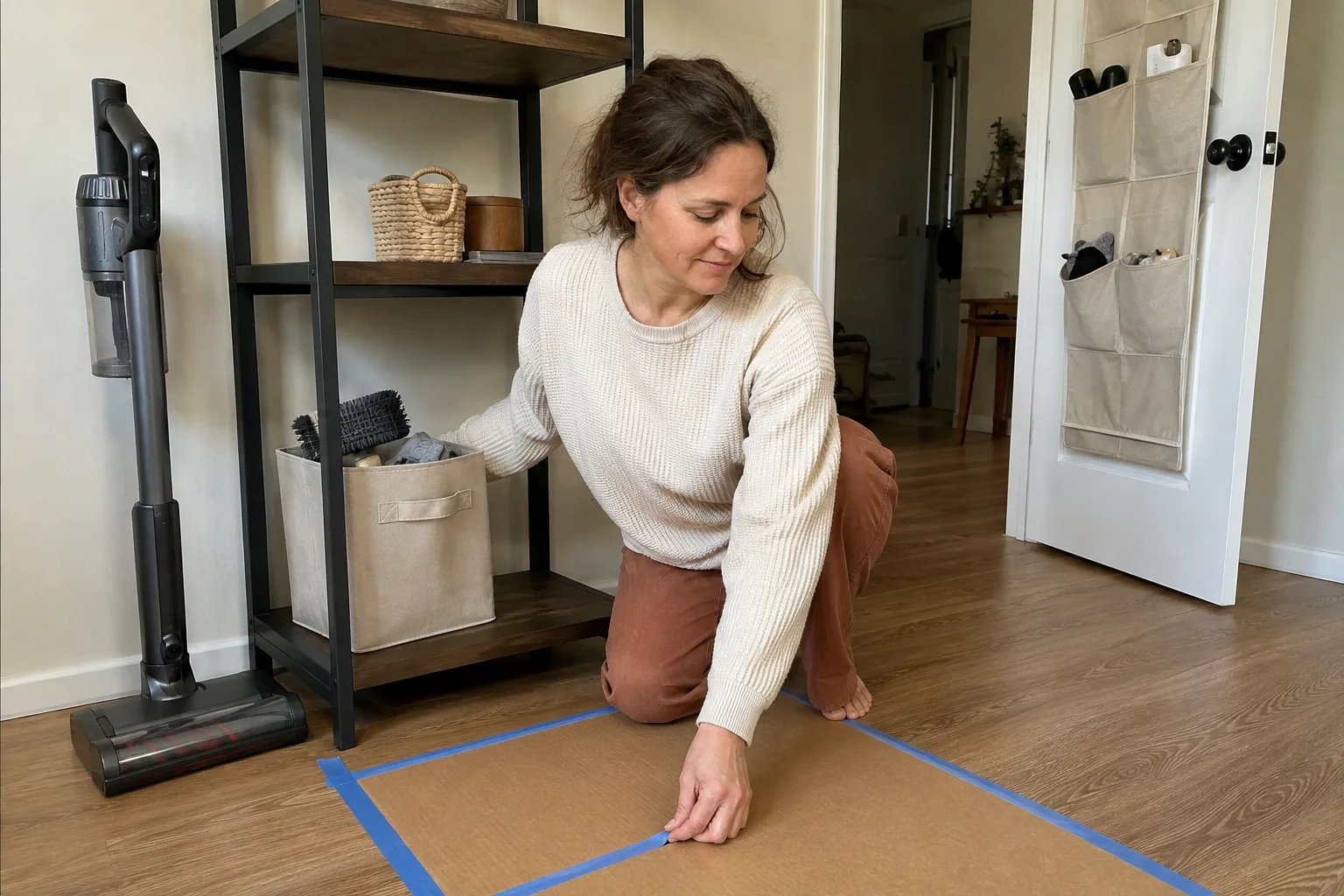
Use painter’s tape or a cardboard footprint to mark the vacuum’s dimensions in a promising spot. Then live with the placement for a few days before adding hooks, shelves, or a dock.
At the edge of a closet
A closet edge is often the most practical choice because the vacuum remains concealed but accessible. Look for unused vertical space beside hanging clothes or next to a shoe rack.
Check whether the floor head blocks other belongings and whether coats fall onto the machine. Dust, damp outerwear, and loose fabric should not cover ventilation openings or charging equipment.
If a shared closet needs broader changes, start with a fair division of rods, shelves, and floor space. This guide to organizing a small closet for two people explains how to assign zones without letting one person’s belongings consume all the accessible storage.
Behind an interior door
The space behind an interior door may hold a slim stick vacuum or an upright with a shallow floor head. Open the door fully and confirm that the handle, knob, and door stop cannot strike the vacuum.
This location works only if the vacuum is secured as its manufacturer directs or stands safely on its own. Do not wedge it between the door and wall. Avoid entry doors, exit routes, and any door that must open fully for access or ventilation.
An over-door organizer can keep lightweight attachments and dry cleaning supplies near the vacuum without consuming floor space. The JARLINK five-shelf over-the-door organizer is approximately 15.7 inches wide, 5.5 inches deep, and 57.8 inches tall. Measure door thickness and closing clearance, and protect the finish as needed. Bulky or heavy vacuum parts may require another solution.
Beside a cabinet or freestanding shelf
A narrow gap beside a wardrobe, media cabinet, or shelving unit can work if the vacuum stands on a level floor and remains outside the walking path. Make sure the furniture does not need to shift whenever you retrieve the machine.
Avoid placing a vacuum beside a stove, radiator, or other heat source. Do not block cabinet doors, floor vents, electrical panels, plumbing access, or appliance ventilation.
Under the bed
Under-bed storage is best for a low canister vacuum or a stick vacuum designed to separate into compact parts. Measure the true clearance beneath the bed, including center supports and sagging fabric under a box spring.
A shallow tray can keep components together and prevent cords from catching on the bed frame. Confirm that the vacuum can lie in that orientation and that its battery may be stored there. Under-bed storage is less suitable for frequent cleaning if pulling out the vacuum requires kneeling, lifting the bed, or moving several bins.
Within open shelving
Open shelving can hold a handheld vacuum, compact canister, or separated stick vacuum if the shelf is deep and strong enough for the item. Keep the vacuum on a low shelf where it cannot fall from overhead.
Use a bin only for lightweight accessories, not as a substitute for supporting a heavy machine. For example, Amazon Basics fabric storage cubes are approximately 10.5 by 10.5 by 11 inches and can group dry, lightweight attachments on compatible shelving. The shelving furniture is not included, and the cubes may not suit rigid or heavy vacuum components.
Create a compact cleaning station without a broom closet
If no single closet can hold everything, build a small cleaning station around one stable storage location. The vacuum should take the floor or wall position, while lighter supplies use a nearby shelf, door organizer, or labeled bin.
Keep the station narrow in purpose. Store vacuum attachments, spare filters, cleaning cloths, and compatible dry supplies there. Do not let it become a catchall for tools, reusable bags, coats, and household overflow. Crowding makes the vacuum harder to retrieve and can cover vents or controls.
Place liquids where leaks cannot reach the vacuum, battery, charger, or outlet. Follow product labels for safe household chemical storage, especially when children or pets can access the area.
Keep cords, hoses, batteries, and attachments under control
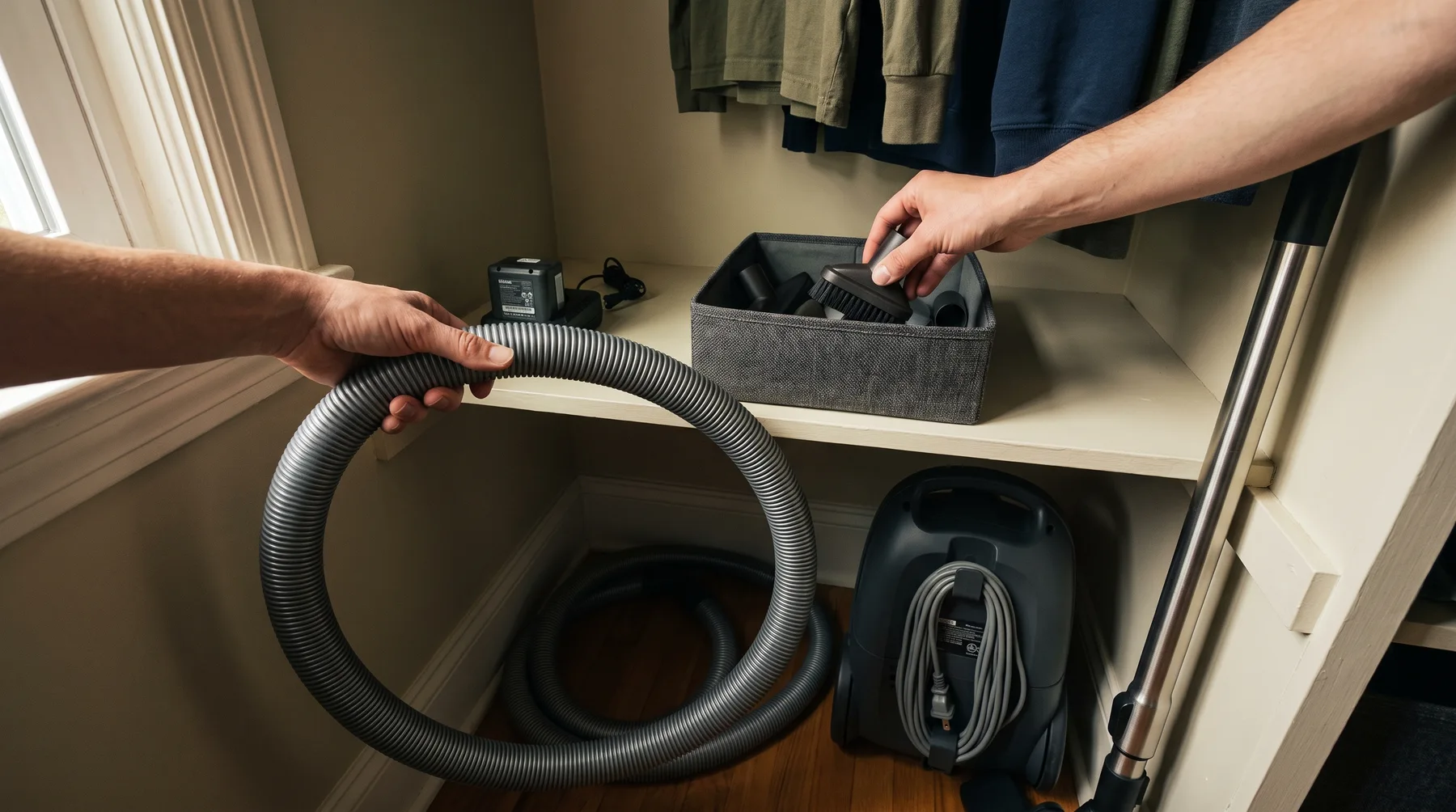
Use the vacuum’s built-in cord wrap when provided. Avoid tight bends near the plug or where the cord enters the machine. If the vacuum has a retractable cord, return it according to the manufacturer’s instructions before storage.
For canister hoses, use a broad coil rather than crushing the hose into a small box. Long wands can stand in a stable corner beside the vacuum or rest on an approved bracket. Small nozzles and brushes can share a shallow bin, provided you can identify and remove them without emptying the whole container.
Labeling can help when several attachments look similar, but detailed sorting is unnecessary if every piece fits in one accessible container. The goal is to avoid losing small parts without dedicating prime floor space to them.
Store and charge batteries only as directed by the vacuum manufacturer. Do not improvise a charging dock, cover a charging battery, or use an extension cord unless the instructions permit it.
Check your lease before installing a wall-mounted dock
Wall mounting can free floor space, but it is not automatically damage-free or lease compliant. Read your lease and ask for written permission if it limits drilling, anchors, or changes to walls.
Use only the mounting hardware and wall conditions allowed by the vacuum manufacturer. The appropriate fastener depends on the wall and the loaded dock, so an adhesive strip is not a universal substitute for screws or anchors.
Also check for hidden electrical wiring and plumbing before drilling. If you cannot verify a safe, permitted mounting point, use a freestanding location or store the vacuum disassembled on a shelf.
Avoid storage that is unstable, damp, or difficult to reset
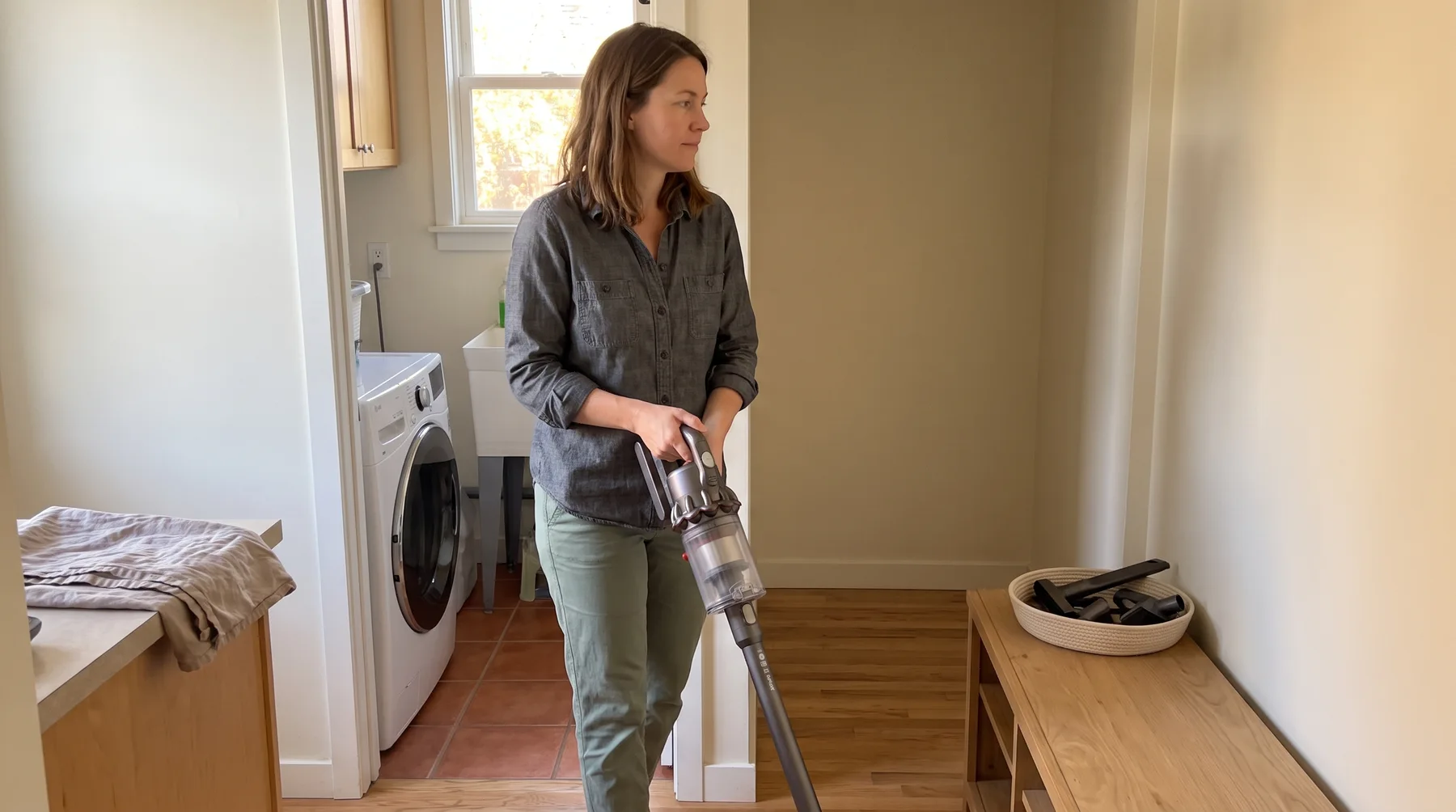
Reject a location if the vacuum tips when lightly bumped, prevents a door from opening, or forces the cord into a tight bend. Bathrooms, damp laundry areas, balconies, and unconditioned exterior storage may also be unsuitable, particularly for batteries and charging equipment.
A complicated setup often fails over time. If storing the vacuum requires removing six boxes or separating parts you use during every cleaning session, those pieces may begin living on the floor instead. Choose a setup you can restore in about the same number of steps it takes to retrieve the vacuum.
Use a final fit and access checklist
Before committing to a location, confirm that:
- The vacuum fits in its real stored configuration with working clearance
- The location supports the machine without leaning or tipping
- You can retrieve it without moving unrelated furniture or storage bins
- Doors, exits, vents, detectors, outlets, and access panels remain clear
- The hose, cord, charger, battery, and attachments have defined places
- Any charging setup follows the manufacturer’s instructions
- The area is dry and away from unsuitable heat sources
- Wall mounting, door hardware, and other installation changes comply with the lease
- You can put everything away without rebuilding the storage area
If two locations pass the checklist, choose the one that matches how often you clean. Daily-use equipment belongs within easy reach. A vacuum used occasionally can occupy a less convenient closet corner or under-bed zone, as long as it remains safe and complete.
Join the conversation
0 comments
Leave a comment
Your email address will not be published. Comments are reviewed before appearing.